Peer-reviewed · British Computer Society
Published research · EVA London 2025
Vision'7-Point Perspective'
A new rule of perspective that ties 1-point, 2-point, 3-point, 5-point and 6-point perspective together. Born from my MFA thesis at the School of Visual Arts, where I showed it in VR, then proven in mixed reality and published by the British Computer Society.
Part 2 of my MFA thesis, Broadening Perspective. Part 1, Empathy
The idea
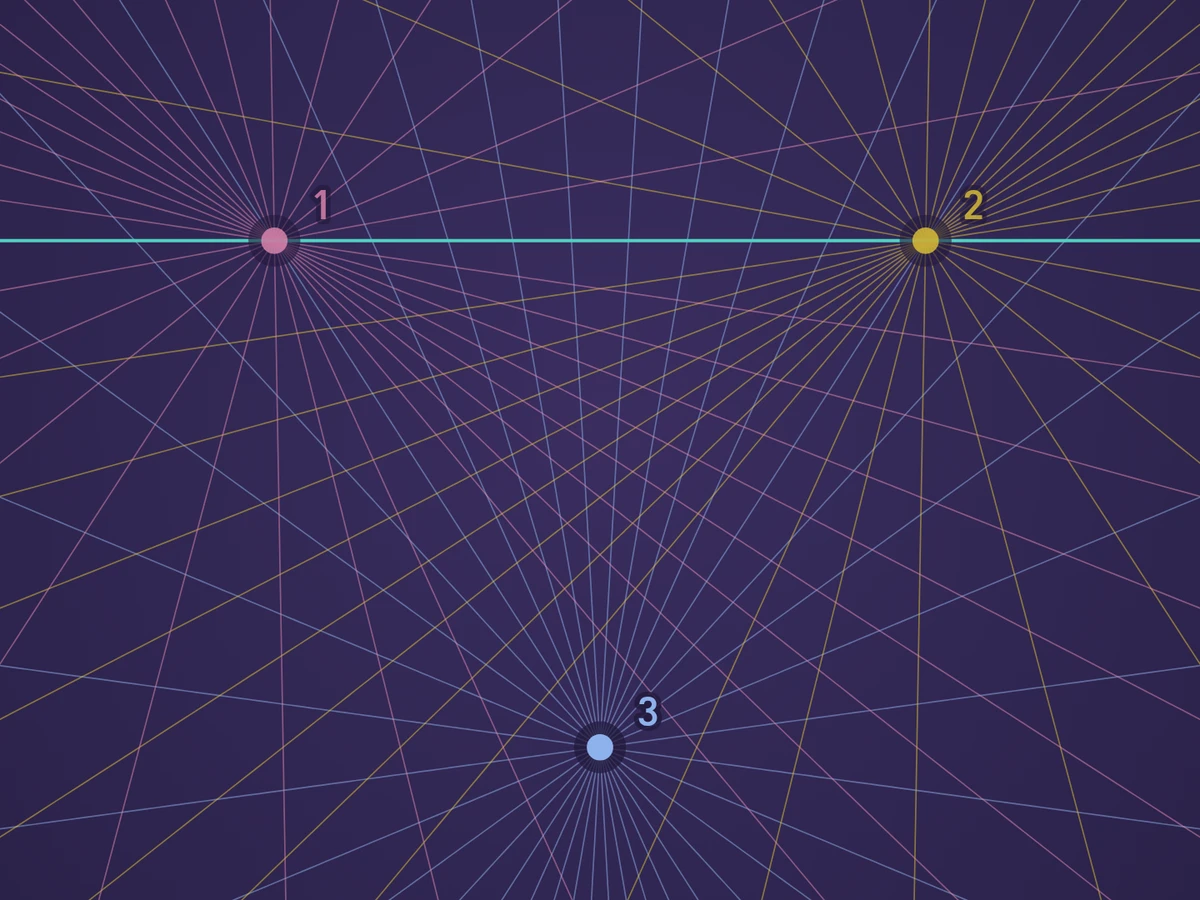
"The art of drawing solid objects on a two-dimensional surface so as to give the right impression of their height, width, depth, and position in relation to each other when viewed from a particular point."Oxford Dictionary
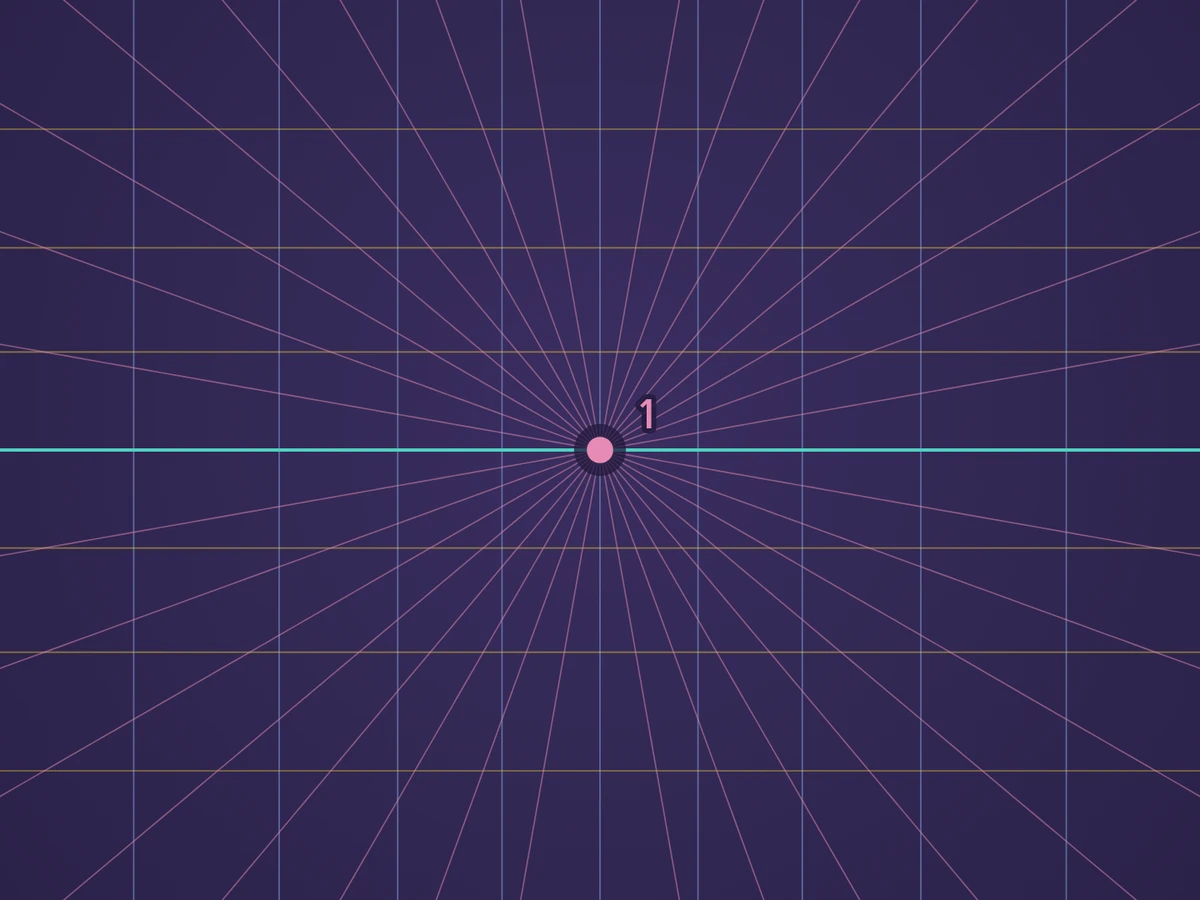
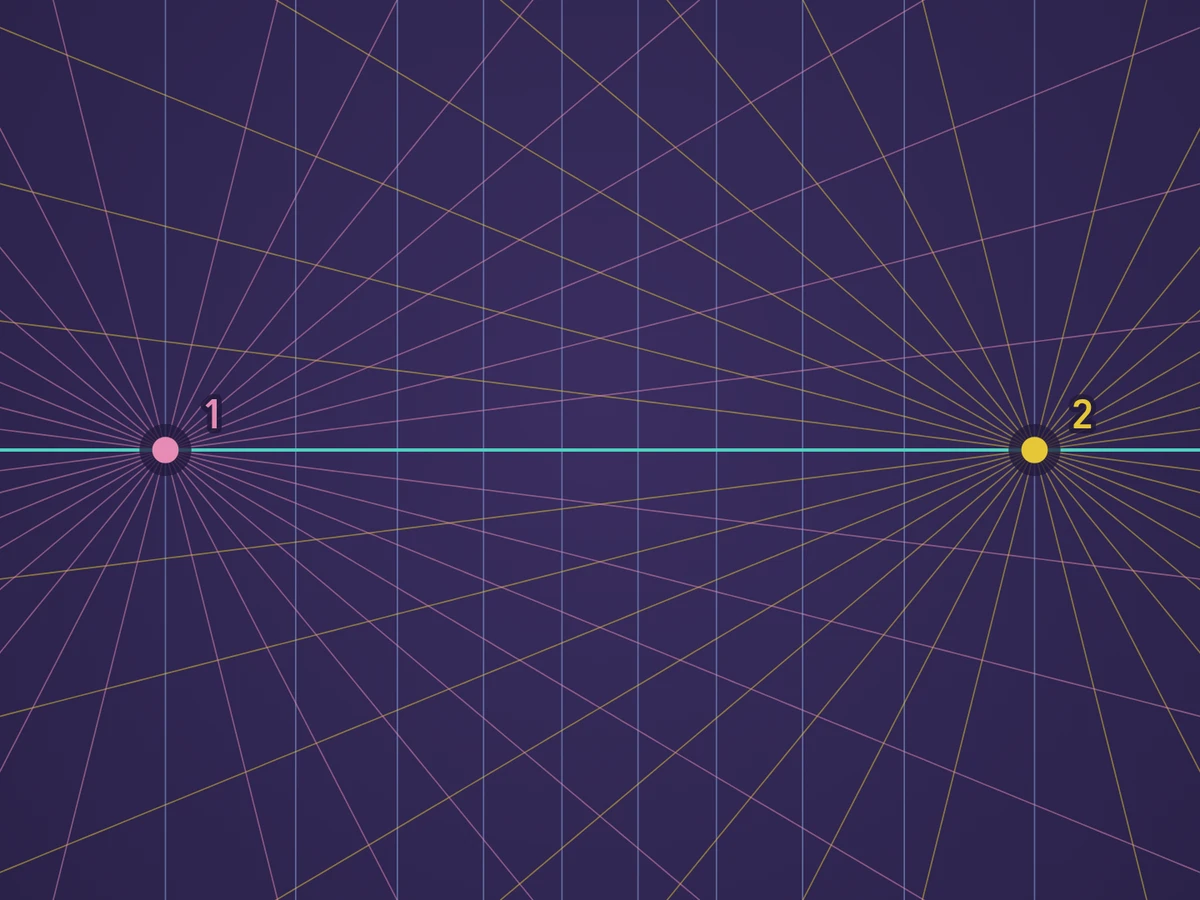
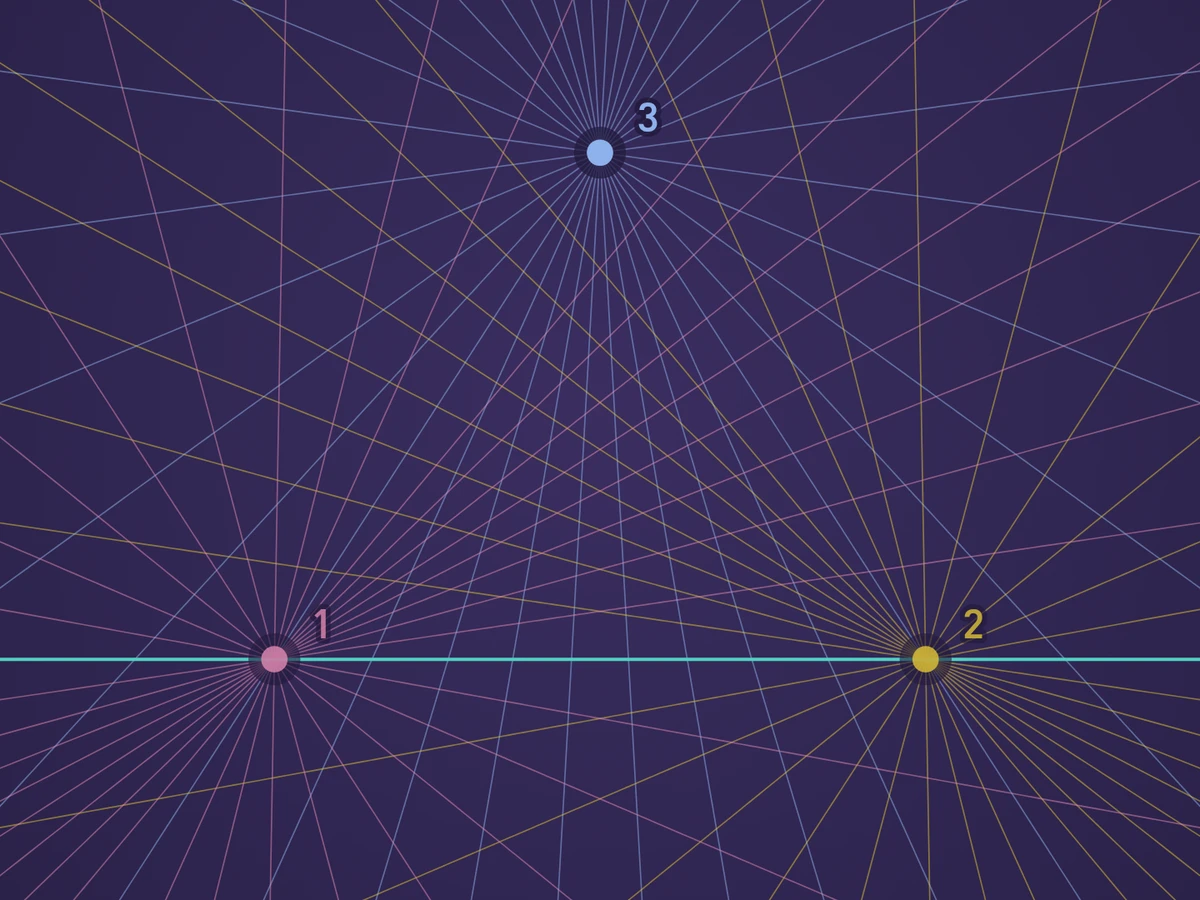
Perspective can be a complicated subject to understand, since there are multiple rules. So far, the main established rules involve 1-point, 2-point, 3-point, 5-point and 6-point perspective.
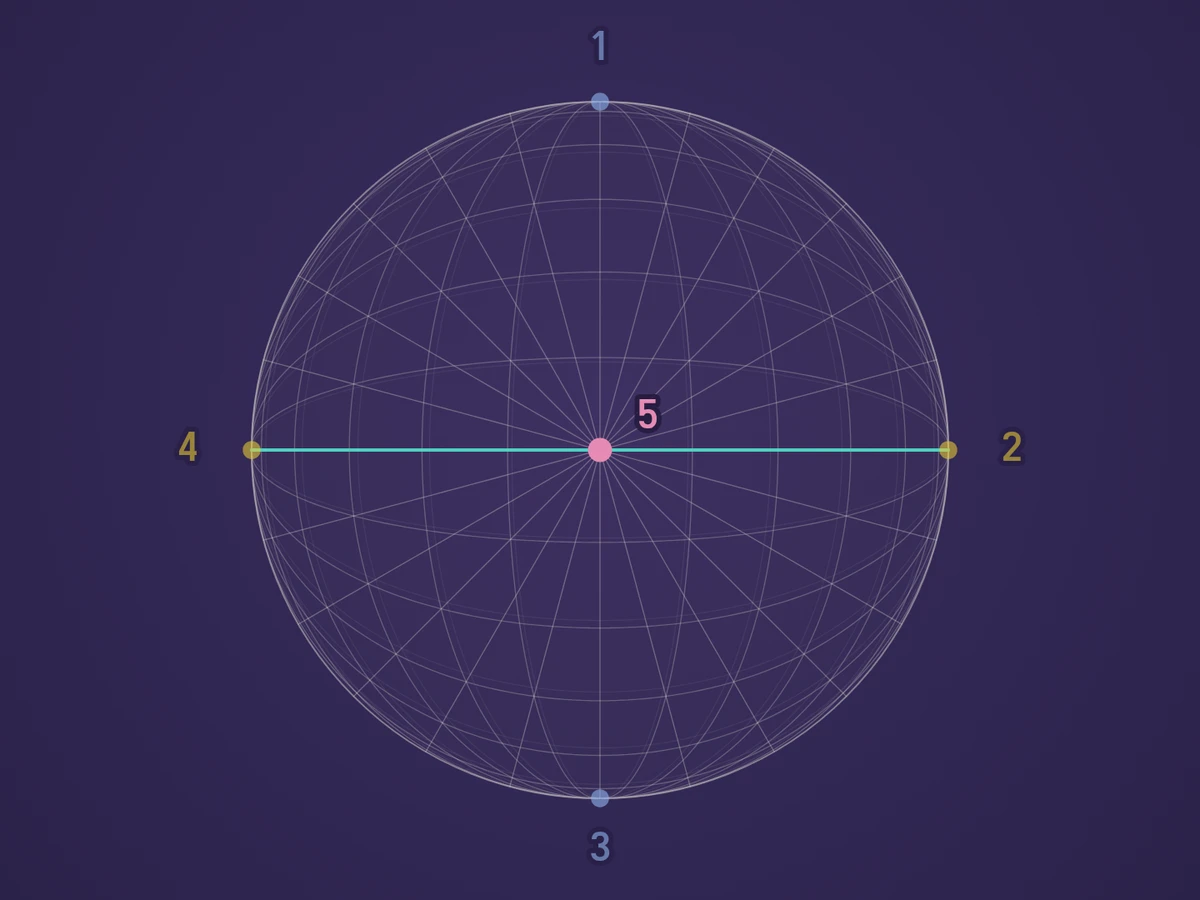
7-Point Perspective is a new rule I coined in my MFA thesis. It shows how the foundational rules are all tied together in the context of how we see the world around us, so artists can understand precisely where each one comes from. I first showed it as an immersive VR experience, and later in mixed reality, overlaid on the real room.
How the sphere works
- 1 front · 3 behind
- 2 right · 4 left
- 5 above · 6 below
- Horizon
- 7 · you
-
01 · A flat circle
It starts with the 5-point grid
5-point perspective is drawn as a flat circle, with a vanishing point above, below, left and right on its edge, and one more in the middle. This is exactly what the 7-point sphere looks like when you view it straight on from the outside.
-
02 · Three points, not one
The centre is hiding two points
Turn the circle and it becomes a sphere. The point in the middle was never just one point. There are three overlapping points, one in front on the surface of the sphere (1), one at its exact centre (7) and one behind, on the back of the sphere (3). Counting those two hidden points gives a sphere with seven vanishing points.
-
03 · The horizon is a circle
Six constant points around you
The horizon line is not just a line. It is a circle that wraps around you horizontally and is always at eye level, with four vanishing points on it (1, 2, 3 and 4). Add the points directly above (5) and directly below (6), and there are six constant vanishing points around you.
-
04 · The seventh point
You are at the centre
The seventh point, at the exact centre, is your point of view. Every other point is relative to it. The sphere moves with you but never rotates on any axis, so the horizon always stays tied to your eye level.
Through your own eyes
Standing at the seventh point, the lines of the sphere become the perspective grids every artist learns. Look straight at a vanishing point and you see 1-point perspective. Shift your focus between two points on the horizon and it becomes 2-point. Tilt your head up or down from there, and the point above or below you joins in, giving 3-point perspective.
Because our field of view is limited, we can only actively see up to 3-point perspective at any moment. However, more than three vanishing points are always influencing what we see.
How I proved it
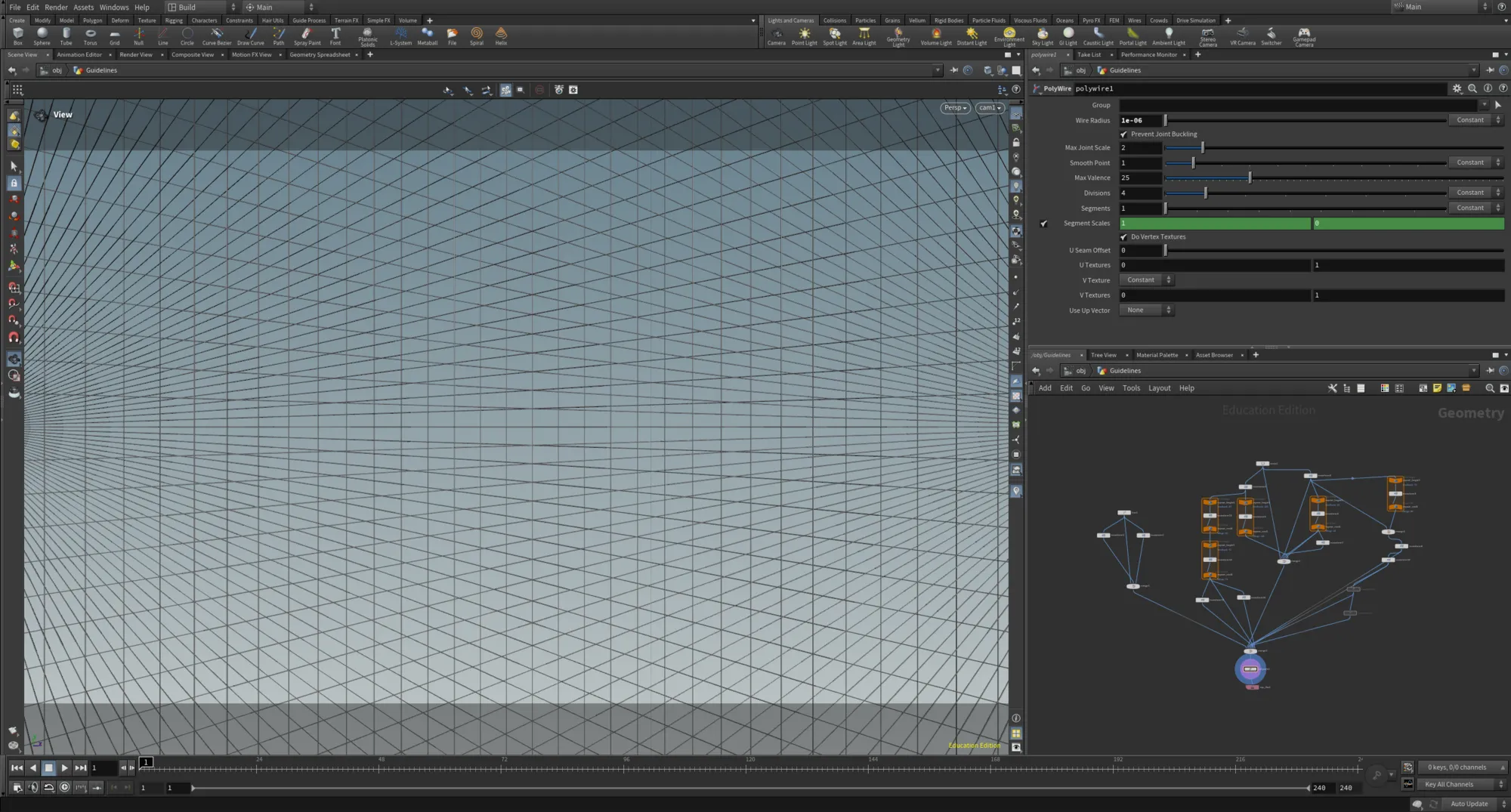
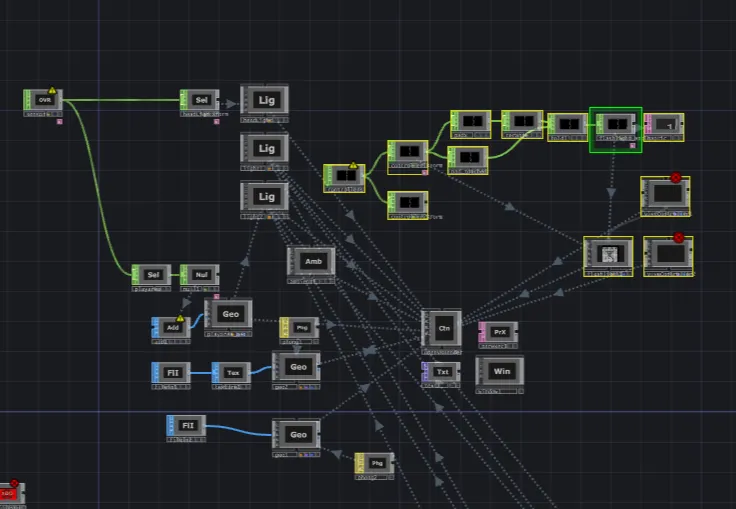
I started by constructing the 7-point sphere in SideFX Houdini, with guidance from Mark Ingle. I then brought it into virtual reality using TouchDesigner, with the guidance and assistance of my thesis advisor, Javier Cruz, who supported me throughout the whole journey. This is how it was shown in my thesis.
In mixed reality, through the headset
For the paper, I brought the sphere into mixed reality on a Meta Quest 3, again through TouchDesigner. Since the viewer's point of view is the seventh point, I anchored it exactly to the centre of the 3D model of the sphere. The sphere moves with you, but it never rotates on any axis, so the horizon line always stays tied to your eye level.
Through the headset, the sphere's lines meet the corners of a real room. Look straight at a vanishing point and the room reads as 1-point perspective. Look between two on the horizon and it becomes 2-point. Tilt up or down and the point above or below you joins in, making 3-point.
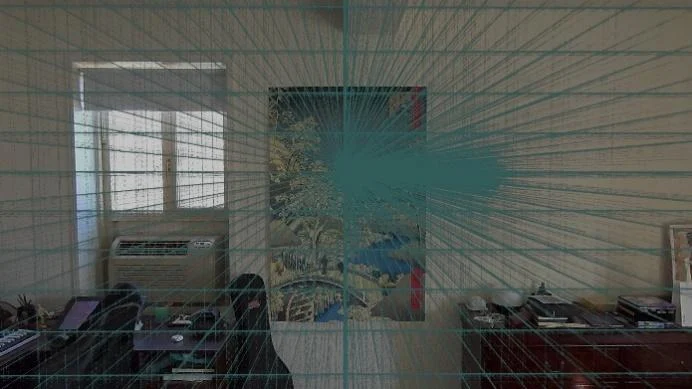
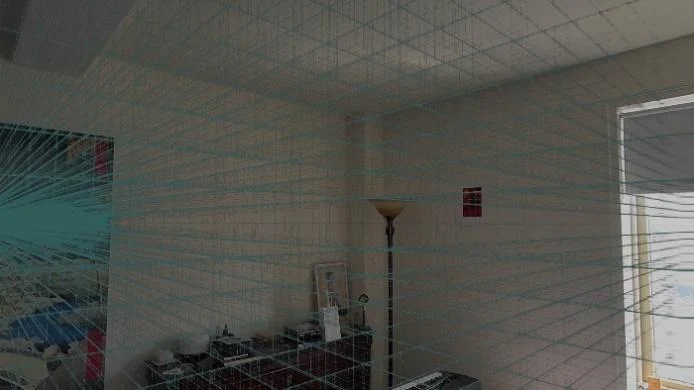
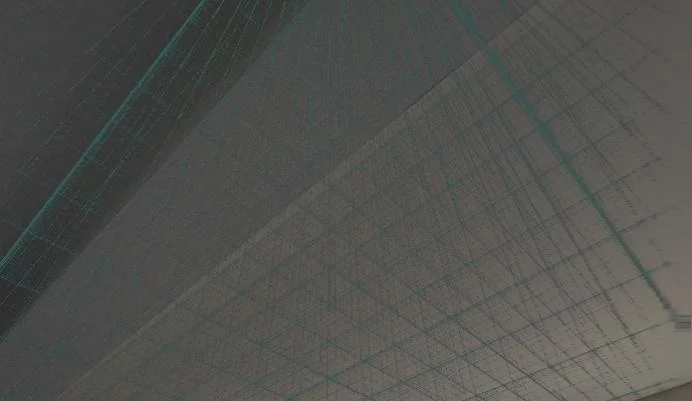
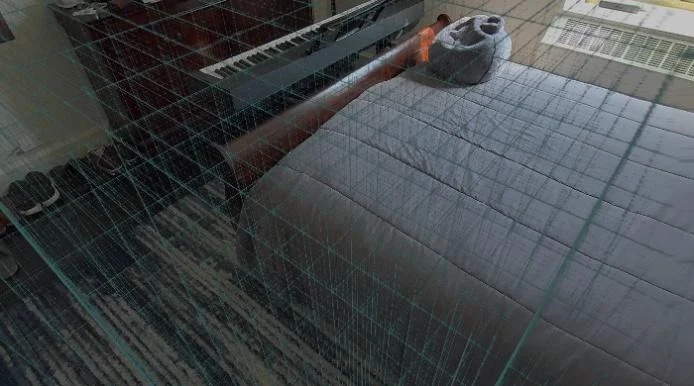
Left-eye captures on the Meta Quest 3, with the sphere anchored to my point of view, from the paper (Figures 10 to 13).
Inside out
The artist Dick Termes discovered 6-point perspective and made artworks on the outside of large spheres. When he looked at them, he saw the inverse of how he perceives the world, because he was viewing the sphere from the outside and could not physically step inside it.
7-Point Perspective puts the viewer inside, at the seventh point. What you see from there is the reverse of that inverse, which is the world as you actually see it.
What it doesn't cover yet
There is one rule of perspective that 7-Point Perspective doesn't address, and that is angled objects. An object that isn't parallel to any axis gains its own vanishing point for each axis it is rotated on.
If it is rotated only around the vertical axis, its new point still lands on the horizon. Rotated on any other axis, its points leave the horizon and sit on the surface of the sphere instead. The seven points of the sphere stay constant either way. In the future, software could scan each object and project its own vanishing points onto the sphere in real time.
Where it could go
I shared the experience informally with four people, the architects Druhan Chhugani and Nico Benjamin Golenia, the physicist and mathematician Ayush Contractor, and Sweder Blanken, a student of Applied Physics. Both architects brought up education, and one said perspective should be taught to architects this way, since it gives a quick and clear understanding of the rules.
Ayush pointed out that it could help explain how other species see. Our eyes face forward, so we see about 180 degrees of the sphere at once, while a deer, with eyes on the sides of its head, sees most of it. Beyond that, it could improve 3D and VR work by anchoring spherical HDRI backgrounds to the camera's point of view, help 2D artists bring their illustrations into 3D, and sharpen anyone's spatial awareness, artist or not.
Published
The research was peer-reviewed and published by the British Computer Society through EVA London 2025, and is available on ScienceOpen.
With thanks
Thesis advisor
Javier Cruz
My mentor in learning TouchDesigner. He guided and assisted me in bringing the sphere into virtual reality, and through every step of my thesis.
Writing mentor
Anney Bonney
My biggest writing mentor and my guide through the whole initial exploration of 7-Point Perspective. She was instrumental to the research as a whole.
Publication
Rochele Gloor
Proofreading, and guidance in getting the paper published at EVA London 2025.
Houdini
Mark Ingle
Guidance in constructing the sphere in SideFX Houdini.
Interviewed
- Druhan ChhuganiArchitect
- Nico Benjamin GoleniaArchitect
- Ayush ContractorPhysicist and Mathematician
- Sweder BlankenStudent of Applied Physics
Where it came from
I had studied perspective for around fifteen years before this, and to be honest, I never truly understood it. I knew 1-point, 2-point and 3-point perspective and what each was supposed to look like, but I couldn't picture how they worked in space.
One day I looked out of my window and decided I wanted to understand perspective right then. I started turning around in circles, watching how everything aligned with everything else, and as I looked up and down, it began to make sense.
What I was seeing was very similar to the 5-point perspective grid. That grid has only ever been looked at as a flat circle, and I realised it should be read as a sphere. Seen as a sphere, there are two more points hidden behind its centre point, which makes seven. That is when I realised we are the seventh point, at the centre of the sphere.